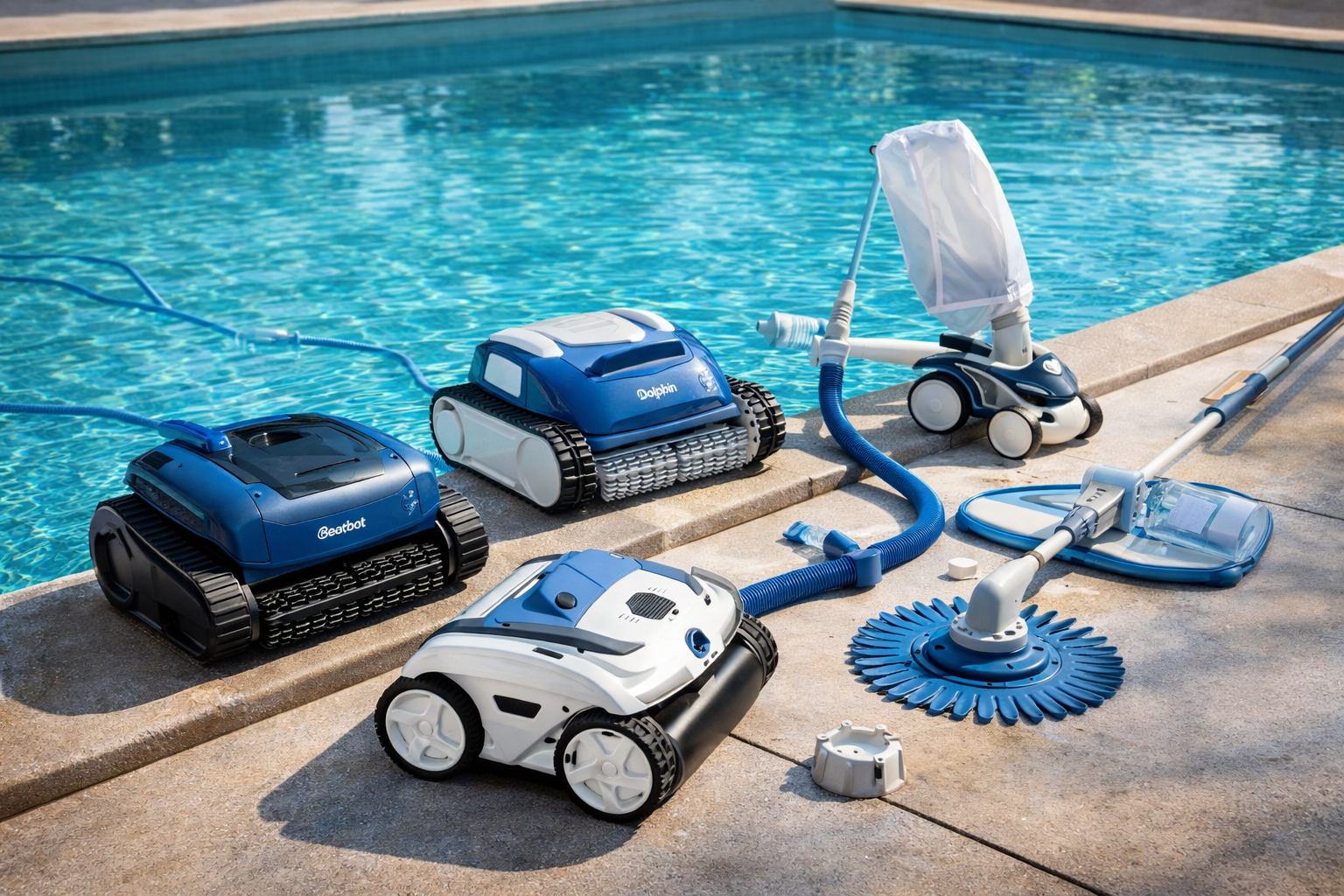
Your pool is one of the best features of your home — and one of the most time-consuming to maintain. The average pool owner spends 30–45 minutes per week on manual cleaning. A quality automatic pool cleaner eliminates most of that. The right model can keep your pool swim-ready with near-zero effort, cleaning floors, walls, and the waterline while you do something else entirely.
The pool cleaner market in 2026 is the most sophisticated it has ever been. The global robotic pool cleaner market was valued at $2.17 billion in 2024 and is projected to reach $5.9 billion by 2034 — a growth rate that reflects just how rapidly pool owners are upgrading from outdated suction and pressure systems to modern robotic units. The “robotic pool cleaner” search term alone draws approximately 165,000 searches per month in the US, with “cordless robot pool cleaner” adding another 60,500.
This guide covers every major pool cleaner type available in 2026, with honest assessments, one top Amazon pick per category, and a comprehensive troubleshooting section for owners already in the water. Jump to the section that fits your situation, or read from start to finish to make the most informed decision possible.
How to Use This Guide
This guide is organized into six parts:
- The 5 types of pool cleaners — what each one is and who it suits
- Robotic pool cleaners — the dominant category, with top picks at every price point
- Suction-side cleaners — the budget-friendly entry point
- Pressure-side cleaners — the leaf-handling specialist
- Manual & handheld cleaners — for spot cleaning and above-ground pools
- Troubleshooting — common problems and proven fixes
Part 1: The 5 Types of Pool Cleaners — Which One Is Right for You?
Before picking a product, pick a type. Choosing the wrong type for your pool and situation is the most expensive mistake buyers make. Here is a clear comparison of all five:
| Type | How It Works | Best For | Price Range | Ongoing Costs |
|---|---|---|---|---|
| Robotic | Independent electric unit, own motor + filter | Any pool; maximum automation | $300–$2,000+ | Low (electricity only) |
| Suction-side | Hooks to skimmer; pool pump powers it | Small pools, fine debris, tight budget | $100–$350 | Medium (filter wear) |
| Pressure-side | Hooks to return jet; collects debris in bag | Leafy yards, pools near trees | $250–$700 | Medium (booster pump energy) |
| Manual/Handheld | Pole-mounted or battery-powered; manual operation | Spot cleaning, above-ground pools, spas | $30–$200 | Very low |
| In-Floor Systems | Permanent pop-up jets built into pool floor | New construction, large inground pools | $2,000–$5,000+ | Low (built-in maintenance) |
The short answer for most buyers in 2026: A robotic pool cleaner wins on every metric except upfront cost. Robotic cleaners are 87% more energy-efficient than pressure and suction-side alternatives, use DC motors that cost roughly 5 cents per hour to operate, and don’t accelerate wear on your pool’s pump and filtration system. If your budget allows for $400 or more, a robotic cleaner is the most sensible long-term investment.
Part 2: Best Robotic Pool Cleaners of 2026
Robotic pool cleaners are self-contained units that plug into a standard GFCI outlet and clean entirely independently of your pool’s plumbing. They have their own motor, pump, brushes, navigation system, and internal filter. The best models can clean your pool floor, walls, and waterline — and schedule themselves to run daily.
The 2026 Market Landscape: What Has Changed
Several significant developments have shaped the 2026 robotic pool cleaner market:
NanoFiltration is now the benchmark for premium models. Standard mesh filters pass fine particles back into the water. NanoFilters — pleated fabric screens with greater surface area — capture particles down to 2 microns, including algae spores and fine silt. Look for this feature specifically on Dolphin ProLine models.
Cordless robots are growing in popularity but still have real limitations. A growing trend toward battery-operated cordless robots has been driven by convenience marketing, but the reality is more nuanced. Battery technology in the sub-$800 cordless category simply has not caught up to corded performance. Cordless robots typically offer 60–120 minutes of runtime versus continuous cleaning for corded units. They are also measurably less powerful. For pools over 40 feet, or pools that accumulate heavy debris, a corded robot will deliver a more reliable clean. Cordless is currently best for smaller pools (under 35 feet) and for owners who prioritize cord-free convenience over cleaning depth.
Battery safety is a real concern after the 2024–2025 Aiper recall. Some reports connected poor-quality battery construction in budget cordless units to overheating risks. When evaluating cordless robots, look for UL or ETL certification and avoid unverified budget brands that have no track record.
The Weekly Timer feature is more important than most buyers realize. Only a handful of robots include a genuine programmable weekly timer that starts the unit automatically without external input. This single feature separates a robot that runs itself from one that requires manual activation daily — completely changing the “set and forget” ownership experience. Models in the Dolphin ProLine (including the Sigma, Premier, and Cayman) include this feature. Most sub-$500 robots do not.
Robotic Pool Cleaner Quick Comparison
| Model | Pool Type | Max Pool Size | Wall Climbing | Weekly Timer | App Control | Price Range |
|---|---|---|---|---|---|---|
| Dolphin Sigma | Inground | 50 ft | Yes (waterline) | Yes | Wi-Fi + Alexa | ~$900–$1,100 |
| Dolphin Premier | Inground | 50 ft | Yes (waterline) | Yes | Yes | ~$800–$1,000 |
| Dolphin Nautilus CC Plus Wi-Fi | Inground | 50 ft | Yes (walls) | No | Wi-Fi | ~$600–$750 |
| Beatbot AquaSense 2 Ultra | Inground | 60 ft | Yes + surface | No | App | ~$2,500–$3,000 |
| Polaris Freedom Plus | Inground | 50 ft | Yes (waterline) | Yes | iAquaLink app | ~$1,600–$1,800 |
| Maytronics Dolphin Liberty 200 | In/Above | 33 ft | Yes (walls) | No | No | ~$500–$650 |
| Wybot C1 | Above/Small Inground | 40 ft | Yes (walls) | No | No | ~$250–$350 |
🏆 Best Overall Robotic Pool Cleaner: Dolphin Sigma
Dolphin Sigma — SmartNav 3.0 navigation, NanoFilters, weekly timer, Wi-Fi + Alexa control
The Dolphin Sigma sits at the top of the 2026 robotic pool cleaner market for residential pools. It is the most advanced model in Dolphin’s ProLine — the commercial-grade motor series that shares components with pool robots used in hotel and resort facilities. In independent testing, the Sigma consistently outperformed competing models in three areas: wall climbing reliability, filter efficiency through its NanoFiltration system, and navigation coverage via SmartNav 3.0.
SmartNav 3.0 maps your specific pool’s shape and calculates the most efficient cleaning route, rather than wandering randomly as most robots do. The gyroscope ensures it stays oriented and doesn’t re-cover the same areas repeatedly. In a standard 40-foot inground pool, the Sigma cleans the entire surface — floor, walls, and waterline — in approximately 2.5 to 3 hours.
The myDolphin Plus Wi-Fi app adds “Connect Anywhere” capability — you can start, pause, and monitor the robot from anywhere, not just Bluetooth range. Voice commands through Alexa and Siri are also supported. The app shows cleaning history, lets you select cleaning modes (floor only, floor and walls, or complete including waterline), and alerts you when the cycle finishes.
The 3-year warranty is 50% longer than standard Dolphin models — meaningful for a device that runs in water daily for months at a time.
✅ SmartNav 3.0 — maps your pool for complete, efficient coverage
✅ NanoFilters — captures algae spores and particles down to 2 microns
✅ Gyroscope for precision navigation across any pool shape
✅ Weekly timer — cleans automatically without daily manual start
✅ Wi-Fi + Alexa + Siri app control from anywhere
✅ Commercial-grade ProLine motors — 3-year warranty
💰 Price Range: ~$900–$1,100
🥇 Best Value Premium Pick: Dolphin Premier
Dolphin Premier — named Best Pool Robot 2026 by USA Today, Multi-Media filtration, leaf bag included
Named the Best Robotic Pool Cleaner of 2026 by USA Today, the Dolphin Premier is the only model in any line that ships with four different filter media options: NanoFilters (fine particles and algae), an Oversized Leaf Bag (large debris and leaves), Standard Filters, and Disposable Debris Bags. This filtration flexibility makes it the best single robot for pools that deal with varying debris types across different seasons.
The Premier is built on the same commercial platform as the Dolphin Wave 75 — a robot sold to commercial facilities for over $2,500. The shared platform means shared commercial-grade components, including the ProLine motors, at a significantly lower residential price point.
Like the Sigma, it includes a weekly timer and full Wi-Fi app control. Unlike many competitors, it has been documented by multiple review sites as capable of cleaning above the waterline — a rare capability even among premium units.
✅ 4 filter media options — the most versatile filtration of any robot
✅ Only Dolphin with an oversized Leaf Bag for heavy debris
✅ Built on commercial Wave 75 platform — proven long-term durability
✅ Weekly timer + Wi-Fi app control
✅ Cleans above waterline — rare capability in residential robots
✅ 3-year ProLine warranty
💰 Price Range: ~$800–$1,000
🏆 Best Mid-Range Robot (Under $750): Dolphin Nautilus CC Plus Wi-Fi
Dolphin Nautilus CC Plus Wi-Fi — 60-ft anti-tangle cord, wall climbing, Wi-Fi app, no monthly fee
The Dolphin Nautilus CC Plus Wi-Fi is one of the most reviewed and recommended robotic pool cleaners at any price point. It delivers wall and waterline cleaning, a 60-foot anti-tangle swivel cord, and full Wi-Fi app control in a package under $750 — making it the best-value point for most average-sized inground pools.
In side-by-side testing documented by Reviewed.com, the Nautilus CC Plus consistently cleaned large pools thoroughly and eliminated the need for any supplemental manual cleaning within the first few weeks of use. Its SmartNav technology ensures the robot follows an efficient cleaning pattern rather than wandering randomly.
The dual scrubbing brushes actively clean all pool surfaces rather than merely gliding over them — an important distinction for pools with algae buildup or gunite texture. It works with concrete, vinyl, fiberglass, and tile surfaces.
Note: Unlike the ProLine robots above, the Nautilus CC Plus does not include a weekly timer. You will need to start it manually or via the app each time. If daily automation matters more than price, step up to the Dolphin Premier.
✅ Wall climbing + waterline cleaning
✅ 60-ft anti-tangle swivel cord
✅ Wi-Fi app control — start remotely from anywhere
✅ Dual scrubbing brushes for active cleaning
✅ Works on all pool surfaces (concrete, vinyl, fiberglass, tile)
✅ No subscription fee
💰 Price Range: ~$600–$750
🏆 Best Cordless Robot: Polaris Freedom Plus
Polaris Freedom Plus — best cordless pool robot, iAquaLink app, auto park at wall, caddy included
The Polaris Freedom Plus is the gold standard for cordless robotic pool cleaners in 2026. If eliminating the power cord is your priority, this is the best-performing cordless option available — though it comes at a premium that reflects its genuinely superior engineering.
The Freedom Plus navigates pools up to 50 feet and cleans both walls and the waterline. When the cleaning cycle ends, it uses its remaining battery charge to drive itself to the pool wall and park — so you can retrieve it easily without reaching across the water. The caddy included in the package enables contactless charging directly from the caddy, so you never have to lift the robot to a charging point separately.
The iAquaLink app offers scheduling, remote control, and status notifications. A weekly timer is included, allowing fully automated scheduled cleaning without manual activation.
At $1,699, the Freedom Plus is a significant investment for a cordless unit. Buyers who want cordless performance without the premium price should consider the Dolphin Liberty 200 ($550), which handles pools up to 33 feet. For larger pools, the Freedom Plus has no serious cordless competition in 2026.
✅ Best cordless performance available for pools up to 50 ft
✅ Auto-parks at wall when cycle ends for easy retrieval
✅ Caddy included — contactless charging, easy transport
✅ Weekly timer — fully automated scheduling
✅ iAquaLink app for remote start and status alerts
✅ Cleans walls and waterline
💰 Price Range: ~$1,600–$1,800
🏆 Best Budget Robot (Under $400): Wybot C1 Pro
Wybot C1 Pro — cordless, wall climbing, 90-min runtime, above-ground and small inground pools
The Wybot C1 Pro is the best-performing sub-$400 pool robot currently available, and it has the advantage of being battery-powered without the premium of higher-end cordless units. It handles floor and wall cleaning on pools up to 40 feet, and its 90-minute runtime is adequate for smaller inground and above-ground pools cleaned on a regular schedule.
Navigation is based on an improved SmartArc path system that avoids complete randomness — it follows overlapping arc patterns to ensure reasonable floor coverage. It does not include a weekly timer or app control, which keeps the price low and the setup simple.
For pool owners on a strict budget or those with above-ground or smaller inground pools, the Wybot C1 Pro delivers cleaning performance that was out of reach at this price point even two years ago. It is not suitable for large pools or heavy leaf debris, but for regular maintenance cleaning of a standard 30-foot pool, it is a strong value.
✅ Cordless — no cable tangling
✅ Wall and floor cleaning
✅ SmartArc navigation for improved coverage
✅ 90-minute battery runtime
✅ Works on above-ground and small inground pools
✅ Budget-friendly entry point to robotic cleaning
💰 Price Range: ~$250–$350
Dolphin vs Polaris vs Beatbot: Honest Comparison
This is one of the most searched comparisons in the pool cleaner category. Here is the clear breakdown:
Dolphin (Maytronics): The most established brand in robotic pool cleaners, with the widest range of residential models. The ProLine series (Sigma, Premier) delivers the best combination of cleaning performance, NanoFiltration, weekly timer automation, and warranty length. Dolphin dominates the $600–$1,100 price range. Best for pool owners who want proven reliability, strong app support, and long-term parts availability.
Polaris (Zodiac/Fluidra): The historic leader in pressure-side cleaners, now making a serious push into cordless robotics with the Freedom Plus and Freedom corded lines. The Freedom Plus is the best cordless option for large pools. Polaris hardware is built to last, and the iAquaLink app is well-regarded. Best for cord-hating owners with larger pools and a higher budget.
Beatbot: The most technologically ambitious brand in the 2026 market. The Beatbot AquaSense 2 Ultra includes surface-level water skimming, an onboard water clarifier dispenser, dual-camera AI navigation, and the most comprehensive pool mapping system available in a residential unit. At ~$2,500–$3,000, it targets premium buyers who want maximum automation and the newest technology. The tradeoff: the brand is newer, and long-term parts availability and service infrastructure are less proven than Dolphin’s.
Verdict:
- Best all-around: Dolphin Sigma or Premier
- Best cordless: Polaris Freedom Plus
- Best for tech enthusiasts with large budgets: Beatbot AquaSense 2 Ultra
- Best for pool-owner-first-timer: Dolphin Nautilus CC Plus Wi-Fi
Part 3: Best Suction-Side Pool Cleaners
Suction-side cleaners are the simplest and most affordable automatic pool cleaners. They connect directly to your pool’s skimmer or a dedicated suction port and use your existing pool pump’s suction to move around and vacuum debris into your filtration system.
Who Should Buy a Suction-Side Cleaner
✅ Buy suction-side if:
- Your budget is under $250
- Your pool is small (under 30 feet)
- Your main debris is fine dirt, sand, and dust (not large leaves)
- You already have a well-maintained pump and filter that can handle extra load
❌ Avoid suction-side if:
- Your pool collects significant leaves or large debris (it will clog rapidly)
- You want wall or waterline cleaning (most suction-side cleaners are floor-only)
- Your pump is aging or already running at full capacity (suction-side adds strain)
- You want any scheduling or automation
The honest disadvantage: Suction-side cleaners force all vacuumed debris through your pool’s filtration system. This accelerates filter wear, shortens filter cleaning intervals, and can significantly reduce pump life over time. These ongoing costs partially offset the lower upfront price.
🏆 Best Suction-Side Pool Cleaner: Pentair 360316 Kreepy Krauly Platinum
Pentair Kreepy Krauly Platinum — no booster pump required, all pool surfaces, 3-year warranty
The Kreepy Krauly Platinum is the most reliable suction-side cleaner for inground pools in 2026. Pentair’s Kreepy Krauly line invented the automatic pool cleaner category, and the Platinum is the brand’s current flagship residential model.
It requires no booster pump — it connects directly to your pool’s dedicated suction port or skimmer and uses existing pump pressure. The four-wheel design prevents the tipping problems common with three-wheel competitors. Front-wheel drive delivers strong traction on inclined pool walls (it will climb the lower portion of walls on gently sloped transitions).
The large-capacity intake throat and debris channel handle leaves and larger debris more effectively than typical suction cleaners — though it still cannot match a robotic or pressure-side cleaner for heavy leaf conditions. It works on concrete, vinyl-lined, and fiberglass pools.
✅ No booster pump required — uses existing pool pump
✅ Four-wheel drive — better traction and wall climbing than 3-wheel models
✅ Large intake throat handles bigger debris than typical suction cleaners
✅ Works on concrete, vinyl, and fiberglass surfaces
✅ Backed by Pentair’s 3-year warranty
💰 Price Range: ~$200–$280
Part 4: Best Pressure-Side Pool Cleaners
Pressure-side cleaners connect to the return jet of your pool’s circulation system — the jets that push treated water back into the pool — and use that water pressure to move around and collect debris. Unlike suction-side cleaners, they capture debris in their own attached bag rather than routing it through your pool’s main filter. This keeps your filtration system clean and extends filter life.
Who Should Buy a Pressure-Side Cleaner
✅ Buy pressure-side if:
- Your pool is surrounded by trees and collects heavy leaf debris consistently
- You already have a dedicated pressure return line installed from your original pool construction
- You want to avoid adding extra load to your pool’s main filter
- Your budget is $250–$700 and you are not ready to move to robotic
❌ Avoid pressure-side if:
- Your pool was not built with a dedicated pressure return line (retrofitting adds significant cost)
- You want wall or waterline cleaning (most pressure-side cleaners clean floors only)
- You want app control or scheduling
- You want maximum energy efficiency (booster pumps use up to 700+ watts)
The booster pump question: Most pressure-side cleaners require a dedicated booster pump to operate effectively. This pump costs $300–$600 to purchase and typically requires professional installation. Always factor this into the total cost when comparing to a mid-range robotic cleaner.
🏆 Best Pressure-Side Pool Cleaner: Polaris Vac-Sweep 280
Polaris Vac-Sweep 280 — proven reliability, dual Venturi jets, 31 ft hose, all inground pools
The Polaris Vac-Sweep 280 is the most consistently recommended pressure-side cleaner in 2026 — a position it has held for well over a decade. Polaris has historically dominated the pressure-side cleaner market, and the Vac-Sweep 280 remains the standard-bearer. With an average rating of 4.2 out of 5 stars across thousands of reviews, reviewers consistently note two things: it handles tight corners better than most competitors, and units have been running reliably for 8–10 years.
The dual Venturi jets deliver strong propulsion through the pool, and the 31-foot hose provides coverage for pools up to approximately 40 feet. The debris bag separates cleanly from the unit for easy emptying. It requires a booster pump (sold separately).
If you are replacing an existing Polaris pressure system, the Vac-Sweep 280 connects to the same fittings as older models — a meaningful advantage that eliminates plumbing work.
✅ The benchmark pressure-side cleaner — proven over many years
✅ Dual Venturi jets for strong floor coverage
✅ Gets into tight corners — better than most pressure-side competitors
✅ Backward compatible with existing Polaris pressure line fittings
✅ Easy-empty debris bag keeps debris out of your main filter
💰 Price Range: ~$250–$350 (booster pump sold separately ~$300–$600)
Part 5: Best Manual and Handheld Pool Cleaners
Manual pool cleaners — vacuum heads on telescoping poles connected to your pool’s filtration system — are the original pool cleaning method. They still have a clear place in 2026, even for pool owners who have a robotic or automatic cleaner:
- Spot cleaning after storms, parties, or algae blooms
- Above-ground pools where running full robotic cycles daily is overkill
- Steps and tight corners that automatic cleaners miss
- Backup cleaning when your automatic cleaner is being serviced or charged
The modern evolution of the manual category is the battery-powered handheld vacuum — a cordless, self-contained unit that uses its own pump to suck debris through a mesh filter. These require no connection to the pool’s plumbing and can clean specific spots in minutes.
🏆 Best Manual/Handheld Pool Vacuum: Water Tech Pool Blaster Max Li
Water Tech Pool Blaster Max Li — rechargeable lithium battery, no hose or pump needed, 60-min runtime
The Pool Blaster Max Li is consistently the highest-rated handheld pool vacuum on Amazon. It is entirely self-contained — no hose, no connection to the pool filter, no poles required for basic operation. A rechargeable lithium-ion battery powers a dedicated suction pump that draws debris into a reusable filter bag.
The 60-minute runtime is sufficient for spot cleaning an entire average above-ground pool or targeting specific problem areas in a larger inground pool. The swivel head fits into corners, steps, and around fixtures that a robot cannot reach. It doubles as the best solution for spa and hot tub cleaning.
✅ No hose or pump connection — fully self-contained
✅ 60-minute rechargeable lithium battery
✅ Reusable filter bag — no replacement costs
✅ Swivel head reaches corners, steps, and tight spots
✅ Works in pools, spas, and hot tubs
✅ Ideal as a backup spot cleaner alongside any automatic system
💰 Price Range: ~$120–$160
Part 6: In-Floor Pool Cleaning Systems — Built-In Is Best
In-floor cleaning systems are permanent fixtures installed during pool construction. A network of pop-up jets embedded in the pool floor activates on a rotating cycle — each zone flushes in sequence, pushing debris toward the main drain for removal by the circulation system.
The honest case for in-floor: If you are building a new inground pool and have the budget, an in-floor system is the most maintenance-free option available. The jets are invisible when inactive, require no retrieval after cleaning, and distribute heated water more evenly throughout the pool — a meaningful bonus for heated pools in cooler climates.
The honest case against: In-floor systems work best in pools built for them from the ground up. Retrofitting is extremely expensive and invasive. They do not work at all without a properly matched variable-speed pool pump. And they do not replace the need for wall brushing or periodic manual cleaning of steps — they only move debris along the floor. A high-end robotic cleaner does more for less.
Bottom line for existing pool owners: Do not retrofit. If you are building new and your budget allows it, in-floor cleaning systems are worth including in the construction plan — particularly for large pools in high-debris environments.
Corded vs Cordless Pool Robots: A Decision Framework
This is one of the most-searched questions in the category (60,500+ monthly US searches). Here is the definitive answer:
Choose Corded If:
- Your pool is over 35 feet in any direction
- You deal with heavy debris (leaves, twigs, acorns)
- You want a weekly timer and full automation
- You want the deepest, most reliable clean
- You prefer to set the robot and leave it running for 2–3 hours
Choose Cordless If:
- Your pool is under 35 feet
- Debris is light and regular (dust, sand, pollen, occasional leaves)
- You clean frequently (every 2–3 days) so each session is shorter
- You want no cord to manage during retrieval
- You have a pool cover that limits debris accumulation between cleanings
The Honest Trade-off Summary
| Corded | Cordless | |
|---|---|---|
| Suction power | Significantly stronger | Limited by battery capacity |
| Runtime | Unlimited (runs until done) | 60–120 minutes |
| Weekly timer | Available (ProLine models) | Rare |
| Cord management | Required (modern 360° swivels minimize tangling) | None |
| Wall climbing | Better (stronger motor) | Good on premium models only |
| Price | Lower for equivalent performance | Premium for comparable cleaning |
Pool Cleaner Maintenance Guide: How to Make Any Cleaner Last Longer
Maintenance is the most underloved topic in pool cleaner content. Here is what every pool cleaner owner should know:
For Robotic Cleaners
After every use:
- Remove the robot from the pool and allow it to drain fully before storage
- Rinse the filters with a garden hose — never use a high-pressure washer
- Inspect the brushes for hair, debris, and wear
Every 4–6 weeks:
- Deep-clean filters with a diluted white vinegar solution (1 part vinegar, 4 parts water) for 30 minutes to dissolve calcium and mineral buildup
- Inspect the drive tracks or wheels for wear, cracks, or missing teeth
- Check the cable for kinks, cracks, or fraying — replace any damaged cable immediately
Every 1–2 years:
- Replace drive tracks (worn tracks significantly reduce wall-climbing ability)
- Replace filter cartridges if cleaning no longer restores proper suction
- Test the power supply unit for voltage output (most professionals check this during seasonal service)
Cordless robots — battery care:
- Never store a cordless robot with a fully discharged battery — charge to 50–60% before long-term storage
- Avoid leaving the battery on the charger for extended periods beyond a full charge
- Store batteries at room temperature — extreme heat or cold accelerates cell degradation
For Suction-Side Cleaners
- Check and clean your pool’s main filter weekly when the cleaner is in use — suction-side cleaners accelerate debris accumulation
- Inspect the hose for cracks, soft spots, and connections monthly
- Check the foot pad and flapper valve — worn foot pads dramatically reduce suction efficiency
- Winterize by disconnecting, draining all water from hoses, and storing at room temperature
For Pressure-Side Cleaners
- Empty the debris bag after every cleaning cycle — a full bag reduces cleaning performance significantly
- Inspect the booster pump quarterly for leaks and unusual noise
- Check and lubricate the hose swivel connections annually
- Inspect the backup valve timing — if the cleaner gets stuck repeatedly in corners, the backup valve timer may need adjustment
Troubleshooting: Common Pool Cleaner Problems and How to Fix Them
This section addresses the most-searched troubleshooting queries for pool cleaners.
My Robotic Pool Cleaner Won’t Climb the Walls
This is the most common complaint submitted to pool cleaner manufacturers. There are five likely causes:
1. Clogged or overloaded filter Remove the filter entirely and run the robot briefly. If it climbs without the filter, the filter is the problem. Deep-clean with the vinegar solution method above, or replace it if it is torn or degraded.
2. Algae or chemical buildup on pool walls Even crystal-clear water can have an invisible biofilm of micro-algae that makes pool walls slippery. Manually brush the pool walls with a pool brush before running the robot, and ensure your water chemistry (pH 7.2–7.6, calcium hardness 200–400 ppm) is balanced.
3. Worn drive tracks or brushes If the tracks are cracked, have missing treads, or have become smooth, the robot loses grip on walls. Replace both tracks simultaneously to maintain balance. Brush condition matters too — worn brushes reduce the robot’s ability to grab the wall surface.
4. Foam climbing rings (if applicable) not yet saturated Some Dolphin models use foam climbing rings that need to absorb water before they provide grip. Allow 10–20 minutes for the rings to saturate before expecting wall climbing.
5. Pool surface incompatibility Freshly acid-washed surfaces, liquid solar blankets, and very smooth plaster can all reduce traction. This is a temporary condition that typically resolves after a few pool chemical cycles.
My Robotic Pool Cleaner Battery Won’t Charge (Cordless Models)
Step 1: Confirm the charging dock is receiving power — check that the dock indicator light is illuminated.
Step 2: Inspect the charging contacts on both the robot and the dock for corrosion, calcium deposits, or debris. Clean gently with a cotton swab and white vinegar.
Step 3: Check whether the battery is completely depleted. Some lithium batteries enter a deep-discharge protection mode and require a “wake-up” charge — connect to the charger and leave for 2–3 hours even if no indicator lights activate initially.
Step 4: Recalibrate the battery if available: remove the battery pack, reinsert it, and then charge fully from 0% to 100% without interruption.
Step 5: Check for a firmware update from the manufacturer’s app or website. Some battery management issues are corrected in software updates.
Step 6: If none of the above resolves the issue, the battery cell itself may have failed. Contact the manufacturer — most robotic cleaners have battery replacements available for $80–$150 within the warranty period.
My Robot Isn’t Picking Up Fine Dirt or Algae
If the robot leaves a dusty residue or visible fine dirt after its cycle:
- Switch to a fine-mesh or NanoFilter cartridge — standard mesh filters pass particles smaller than 200 microns back into the water
- Ensure the cycle is long enough for your pool size — many robots need 2–3 hours to cover a 40-foot pool thoroughly
- Check that brush rotation is working correctly — press the brush gently by hand; if it doesn’t spin freely, check for debris wound around the axle
- For algae specifically: algae-affected pools may need 2–3 cycles on consecutive days to fully remove established growth, combined with proper chemical shocking
My Robot Gets Stuck on Pool Steps or in Corners
Most robotic pool cleaners are not designed to navigate standard pool stairs — the step height is simply incompatible with the robot’s wheel geometry. This is a design limitation, not a malfunction.
Solutions:
- Brush debris on stairs manually before running the robot — this pushes step debris to the floor where the robot can collect it
- Use the manual control / remote drive feature (if your model has it) to steer the robot away from stairs at the start of each cycle
- Some robots, including Dolphin models, allow you to place the robot at the mid-point of the pool length at the start of each cycle — this minimises the chance of the robot encountering stairs early in its navigation
My Suction-Side Cleaner Has Stopped Moving
- Check that the pool pump is running at full speed — suction cleaners need full flow to operate
- Inspect the hose connections for air leaks — even a small crack allows air into the line and drops suction
- Check the foot pad and flapper valve under the cleaner — if worn or cracked, the suction seal is broken
- Clean the pool’s main filter — a dirty filter restricts pump flow and prevents the cleaner from moving
- Verify nothing is blocking the skimmer basket or the dedicated suction port
My Pressure-Side Cleaner Has Stopped Moving
- Verify the booster pump is running and circulating pressure through the return line
- Check the pressure return line for kinks or blockages
- Inspect and clean the backup valve — a stuck or failed backup valve stops the randomising reverse motion and causes the cleaner to spin in place
- Empty the debris bag — a completely full bag stops water flow through the cleaner and halts movement
- Inspect all hose connections for leaks — pressure drops from any leak reduce propulsion significantly
Frequently Asked Questions
Do robotic pool cleaners work in saltwater pools?
Yes. All major robotic pool cleaners — including the Dolphin and Polaris models listed above — are compatible with saltwater pools. The salt concentration in residential saltwater pools (typically 2,700–3,400 ppm) is well below the threshold that damages standard pool robot components. Always confirm saltwater compatibility in the specific model’s specifications.
Can I leave my robotic pool cleaner in the pool all the time?
No. Remove the robot from the pool after each cleaning cycle. Leaving it in the pool exposes the seals, brushes, and cable to UV radiation, chemical concentration fluctuations, and unnecessary immersion time — all of which shorten its lifespan. Most manufacturers recommend storing the robot out of direct sunlight when not in use.
How often should I run my pool robot?
For a well-maintained pool, 2–3 times per week is standard for most inground pools. Pools near heavy vegetation, pools used frequently, or pools in high-dust environments may benefit from daily cycles. If your robot has a weekly timer, setting it to run every other day is a good baseline that you can adjust based on visible cleanliness.
Do I need to run my pool pump when the robot is cleaning?
No — this is one of the most significant advantages of robotic cleaners. Because they have their own motor and filter, they are entirely independent of your pool’s circulation system. You can run your pool pump on a reduced schedule when the robot is handling debris collection, which reduces energy costs.
Can a robotic cleaner replace my pool chemicals?
No. A robot cleans physical debris and can improve water clarity, but it does not sanitize the water. Chlorine (or an alternative sanitizer), pH balancing, and regular water testing remain essential regardless of which pool cleaner you use.
What is the best pool cleaner for above-ground pools?
The Dolphin Escape and the Wybot C1 Pro are the best options for above-ground pools under $500. For above-ground pool owners who want a no-electricity, no-cord option, the Pentair Kreepy Krauly suction-side cleaner (with skimmer adapter) handles fine debris in smaller above-ground pools for under $250. The Water Tech Pool Blaster Max Li is the best handheld option for above-ground spot cleaning.
Final Buying Recommendations by Budget
| Budget | Best Option | Why |
|---|---|---|
| Under $200 | Water Tech Pool Blaster Max Li | Best handheld/above-ground cleaner — reliable, no ongoing costs |
| $200–$300 | Pentair Kreepy Krauly Platinum | Best suction-side entry point for inground pools |
| $300–$400 | Wybot C1 Pro | Best budget robotic — cordless, wall climbing, simple operation |
| $400–$700 | Polaris Vac-Sweep 280 (+ booster pump) | Best pressure-side for leafy pools — or stretch to Nautilus CC Plus |
| $600–$800 | Dolphin Nautilus CC Plus Wi-Fi | Best mid-range robotic — wall climbing, app, proven reliability |
| $800–$1,100 | Dolphin Premier or Dolphin Sigma | Best overall — NanoFilters, weekly timer, ProLine motors |
| $1,600–$1,800 | Polaris Freedom Plus | Best cordless — large pools, premium automation |
| $2,500+ | Beatbot AquaSense 2 Ultra | Best for technology-first buyers; surface skimming + AI nav |
The Bottom Line
The pool cleaner you buy in 2026 will directly determine how much time you spend — or don’t spend — maintaining your pool. The right robotic cleaner effectively automates the entire cleaning process. The wrong type for your pool and situation creates frustration, ongoing costs, and eventually a return to manual brushing.
For the majority of inground pool owners, the Dolphin Premier or Dolphin Sigma delivers the best combination of cleaning performance, automation, filter quality, and long-term reliability. For smaller pools on a tight budget, the Wybot C1 Pro or Pentair Kreepy Krauly Platinum covers the basics without the upfront investment of a premium robot.
Whichever you choose, proper maintenance — rinsing the filters, inspecting the brushes, and storing the unit correctly — will extend its life by years and protect what is, for most buyers, a meaningful investment.
Last updated: March 2026. Prices are approximate and subject to change. Always verify compatibility with your specific pool size, surface type, and plumbing before purchasing.